




Free Shipping on Most Orders Within the Continental U.S. (Excludes AK/HI)
30-Day Returns
Secure Checkout on Every Order
Trusted by Outdoor Stargazers Across the Community
Built for the Horizon
Every product in our catalog is selected against one standard: does it hold up when you are far from a trailhead and the sky is doing something worth watching. We stock telescopes, glamping tents, lanterns, and binoculars chosen for verified specs, real materials, and field-ready construction. Free shipping on most orders within the Continental U.S., 30-day returns, and a support team reachable by phone or email when you need a straight answer.
Questions We Get a Lot
Aperture is the single most important number on a telescope spec sheet. For planets, 70–90mm of aperture resolves surface detail on Jupiter and Saturn under steady skies. For deep-sky objects like nebulae or star clusters, more aperture gathers more light, so larger objectives produce brighter, more resolved images. Match the aperture to what you plan to observe most, not to the highest magnification printed on the box.
Magnification is calculated by dividing the focal length of the telescope by the focal length of the eyepiece. A higher number sounds better, but usable magnification is limited by aperture — roughly 2x per millimeter of objective diameter under good conditions. Pushing past that threshold produces a dim, blurry image, not a sharper one. The low-end magnification figure tells you more about practical everyday use than the ceiling number does.
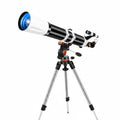
Refractor telescopes with aluminum tube construction travel reasonably well and require no mirror collimation in the field. The mount matters as much as the optics: an alt-azimuth mount assembles and levels quickly on uneven ground, which suits campsite use. Carry the optical tube in a padded case and allow 20–30 minutes for the optics to acclimate to ambient temperature before observing for best image quality.
Most orders ship free within the Continental U.S. — Alaska and Hawaii are excluded. If the instrument does not meet your expectations, our 30-Day Return Policy applies. Review the full terms in our Return Policy for eligibility details and the process for initiating a return.
About Our Telescopes
A telescope solves one problem precisely: it collects more light than the naked eye can and bends it to a focal point where a magnified image becomes visible. The critical variable is aperture, measured in millimeters at the objective lens. A larger aperture admits more photons, which directly determines how faint an object you can resolve and how much surface detail emerges on nearby planets. Focal length and the eyepiece together set magnification, but aperture sets the ceiling on what that magnification can actually show. Refractors use a lens at the front of the tube and require no collimation in the field, which makes them practical for travel. Smart telescopes add onboard sensors and image processing that assist with object location and capture, useful when light pollution compresses the observing window. Mount design matters for stability: a wobbly mount wastes good optics. Think about portability, the type of objects you want to observe most, and how much setup time you are willing to accept at the site before choosing.